

Crucible is a firm that has strong capital markets and financial engineering roots. I believe this competence is more relevant and consequential than any other time in startup history. This will become glaringly evident over the next decade.
Narrative Violation
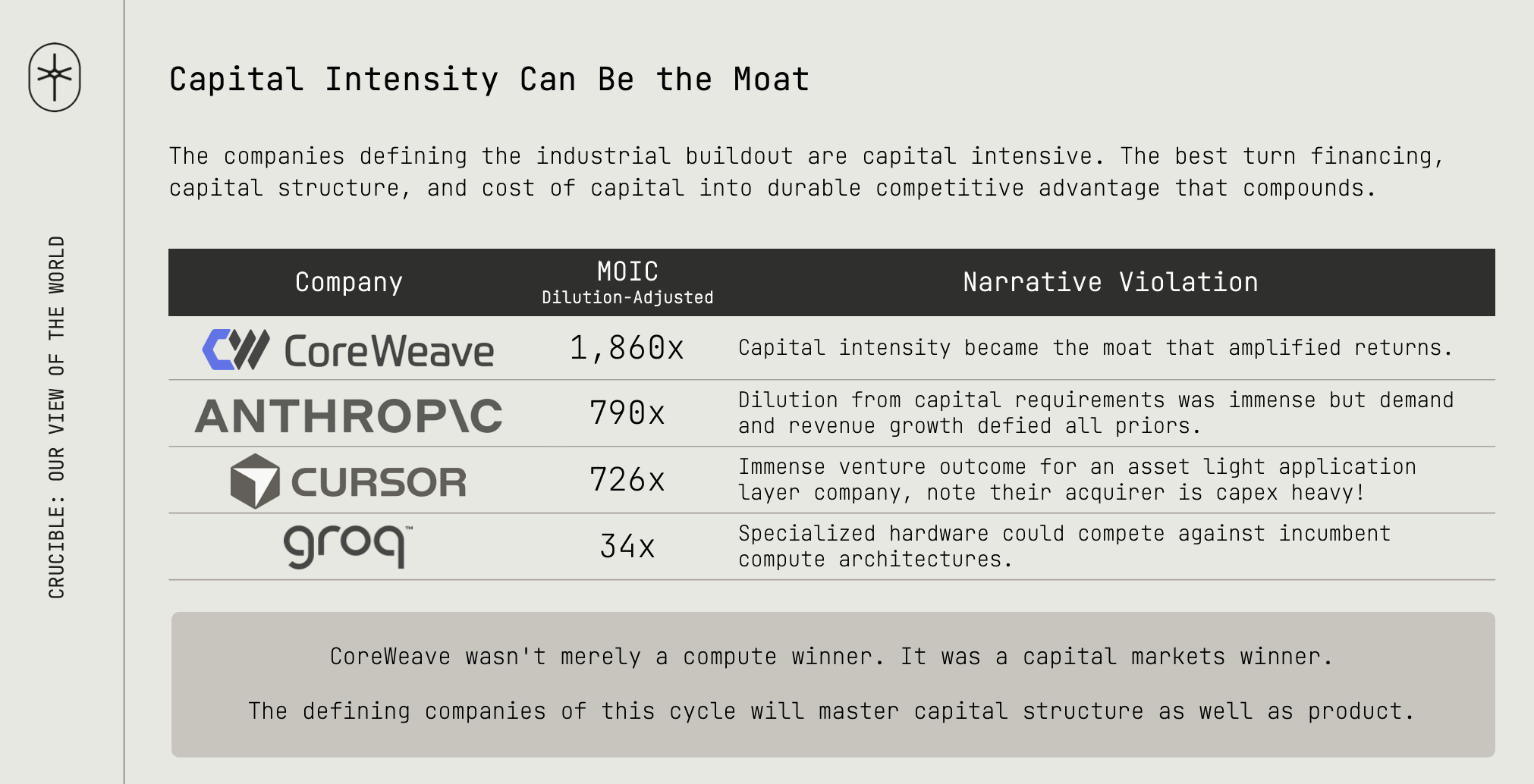
Capital intensity is the moat for many of venture’s best outcomes in this era of AI and infrastructure. The companies that are winning have been able to turn financing, capital structure, and their cost of capital into a durable competitive advantage that compounds.
Understanding Capital as a Moat
Founders spend enormous amounts of time thinking about how to compound traction.
More customers create references that win more customers.
More revenue funds better products.
Better products attract better talent.
Better talent accelerates execution.
Each milestone makes the next milestone easier.
But for founders building capital-intensive companies, there is another compounding loop that matters just as much: CAPITAL
The current infrastructure and deep tech boom is partly possible because venture capital has dramatically changed the cost of capital available to startups.
Understanding the Cost of Capital
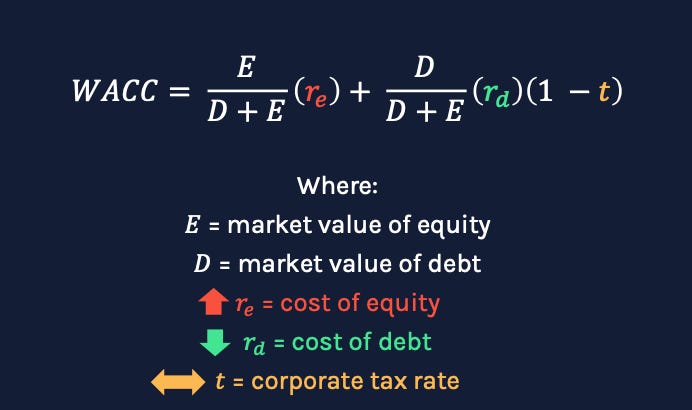
A company that could never borrow $100M on attractive terms may be able to raise $100M of equity at a $1B valuation. At sufficiently high valuations, dilution becomes remarkably inexpensive relative to the interest, covenants, collateral requirements and restrictions associated with debt—if debt is available at all.
For those of you who like formulas, this the weighted average cost of capital from Miller and Modigliani’s seminal 1963 paper “The Cost of Capital, Corporation Finance and the Theory of Investment.” This is the bedrock of modern corporate finance.
This means founders need to understand something fundamental:
Your ability to compound capital is part of your company’s traction.
Your Company has Two Products
For capital intensive businesses (which is becoming all businesses because energy and compute are f***ng expensive and only getting more expensive), I increasingly think founders are building two products simultaneously.
The first is the obvious one: the product you sell to customers.
You are trying to make it increasingly valuable, credible and easy to buy.
The second is less obvious: the risk you sell to capital.
You are trying to make your company increasingly legible, credible and financeable to progressively larger pools of capital. The progression might look like this:
Early-stage venture investors might finance a founder and an idea.
The next investor finances evidence that the idea works.
Later stage investors finance growth.
Lenders finance contracted cash flows and assets.
Project finance investors finance predictable projects.
Infrastructure capital finances increasingly standardized deployments.
Public markets finance scale and lower the cost of capital by enabling the issuance of CP (commercial paper)
Each milestone should therefore do two things:
increase the value of the company AND decrease the perceived risk of financing the next stage of the company.
That is capital compounding.
Capital has its own Momentum
The best founders intuitively understand this.
A great seed round isn’t simply $5M in the bank. It should finance the milestones that make $20M available.
That $20M should create the evidence that makes $100M available.
That $100M should build assets, contracts, revenue or infrastructure that unlock entirely different pools of capital.
Eventually, something that initially required extraordinarily expensive risk capital may become financeable with much cheaper forms of capital.
The progression might look something like:
idea → technical proof → customer validation → contracts → revenue → assets → predictable cash flows
And alongside it:
founder capital → venture equity → growth equity → structured capital → asset-backed debt → project finance → infrastructure capital / public markets
The objective isn’t simply to continuously raise more venture capital.
The objective is to continuously expand the universe of capital willing to finance you.
Every Milestone Should Unlock Something
This is why I tell founders to think about fundraising long before they need money. Your next financing should be an output of the milestones you are already producing.
A technical milestone can remove technology risk.
A major customer can remove demand risk.
A long term contract can transform uncertain future revenue into something financeable.
A functioning deployment can remove execution risk.
Standardized unit economics can make the next project underwritable.
Assets can create collateral.
Predictable cash flows can facilitate low cost debt.
Scale can introduce infrastructure investors or public markets.
Great execution doesn’t just increase valuation. It changes who can finance you and what they will charge.
That distinction matters enormously. Going from a $100M valuation to a $1B valuation makes equity and debt cheaper. Going from a business that can only raise equity to one that can access multiple forms of capital changes the company much more fundamentally.
Capital Markets are a Form of Distribution
Founders understand that customer relationships compound. Founders need to internalize that capital compounds too, and is likely the most consequential to growth.
The investor who watches you execute a seed round may lead the Series A. The growth investor who follows the company for two years may eventually write a $100M check. The lender who finances one deployment may finance ten. The infrastructure investor who understands the first project may eventually fund an entire portfolio.
This is why capital markets should not be treated as a periodic fundraising exercise.
You should be building relationships with the people who can finance the company one, two and three stages from now.
Tell them what you are going to do. Do it. Show these investors and talk to them about your growth. Repeat. Every completed cycle increases credibility, and that credibility lowers the cost of capital in each successive round.
The Dangerous Assumption
There is an important caveat to all of this.
Today’s venture market has made equity unusually abundant for a relatively small number of companies. Large amounts of capital are competing for companies perceived to be exceptional. That competition drives valuations higher, which lowers the effective cost of equity and allows companies to pursue increasingly capital intensive projects.
That creates a powerful reflexive loop:
capital abundance → higher valuations → cheaper equity → greater ambition → larger capital requirements → larger rounds
But founders should not assume this regime lasts forever. If your business only works because someone will always fund the next round at a dramatically higher valuation, you don’t have a capital strategy. You have a market assumption.
The strongest companies use periods of abundant capital to graduate toward more durable and diversified sources of capital.
As a VC: Underwrite the Company and Underwrite the Capital
This is why at Crucible, when we look at capital-intensive businesses, we think about underwriting two things:
The company
The capital
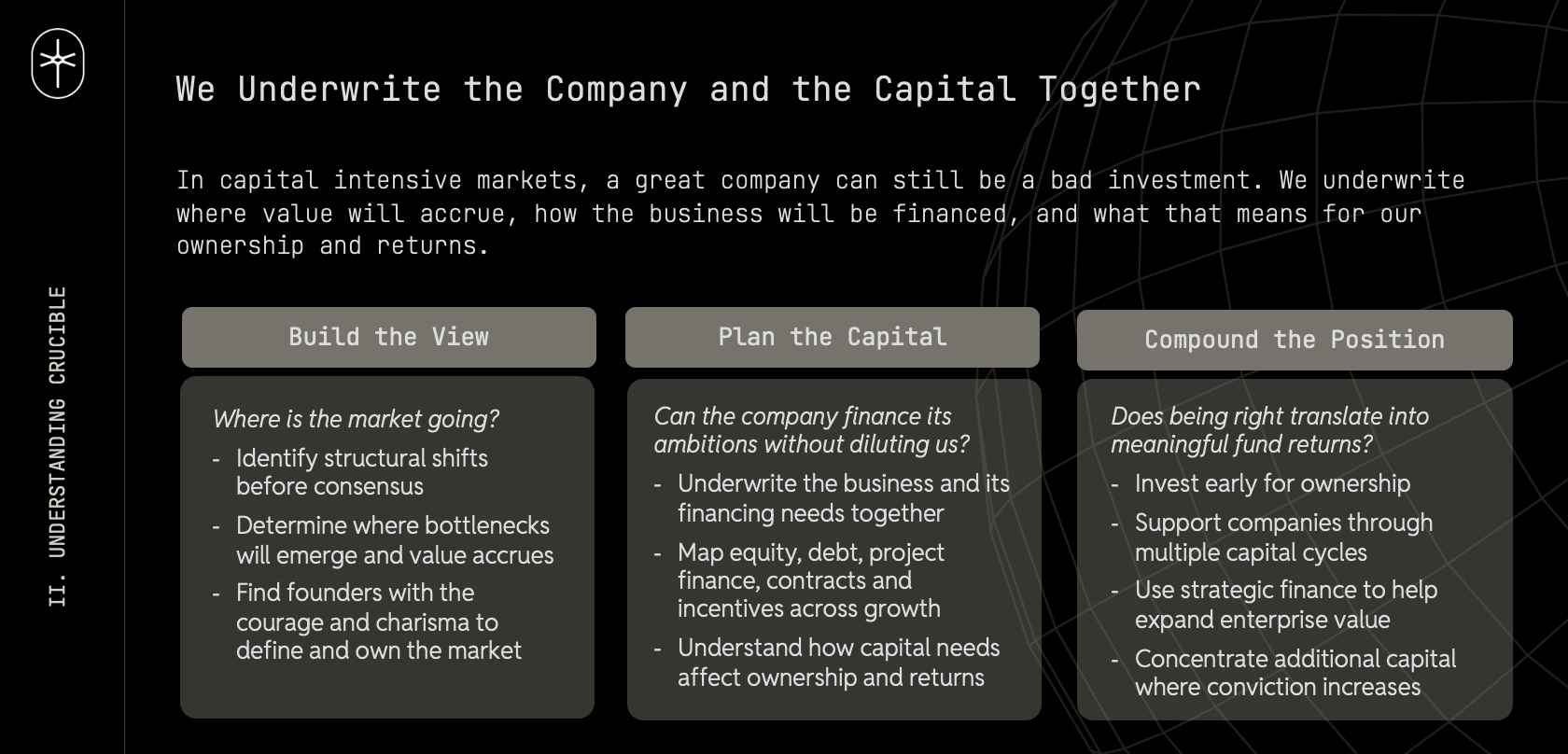
This means we have to ask two questions at once:
The company: Can the technology work? Do customers want it? Can the team execute? Can the business generate attractive economics?
The capital: How much capital will this company ultimately consume? What milestones unlock the next pool? Who provides that capital? What instrument should they use? What does that capital cost today? What happens if that cost doubles? Can equity eventually be replaced by cheaper capital?
And, most importantly:
Does every dollar raised make the next dollar easier to raise?
For founders building infrastructure, energy, compute, manufacturing, materials or other capital intensive businesses, capital formation isn’t a finance function sitting adjacent to company building.
It is company building.
Product compounds.
Customers compound.
Talent compounds.
Distribution compounds.
Capital compounds too.
Build accordingly.
Crucible invests from idea through inflection in companies driving structural shifts across energy, compute, materials, and the markets that finance and coordinate them. We write $1-3M checks at inception and scale our invested capital through to IPO.
This really landed. Solidly helpful perspective, thanks
Think the framing that a founder is selling (1) a product and (2) their risk is very helpful, thanks!
Imo capital intensity creates some unbelievable opportunities for old-school ring-fencing and securitisation to launder blended cost of capital down (effectively the point of selling risk). GC’s CVF is doing this nicely imo
Curious if you guys have seen / heard much around full stack term sheets? Ie founders doing debt / equity / hybrid capital rounds simultaneously?